



Key Takeaways
- Exchange OS launched on OKX’s Xlayer on May 26, enabling anyone to deploy spot and perp markets.
- Glassnode joined as Exchange OS’s data provider, supplying onchain and derivatives data to Xlayer.
- The permissionless protocol enters a space led by Hyperliquid, which recorded $170.29B in monthly volume recently.
Glassnode Powers Exchange OS Launch on OKX’s Xlayer
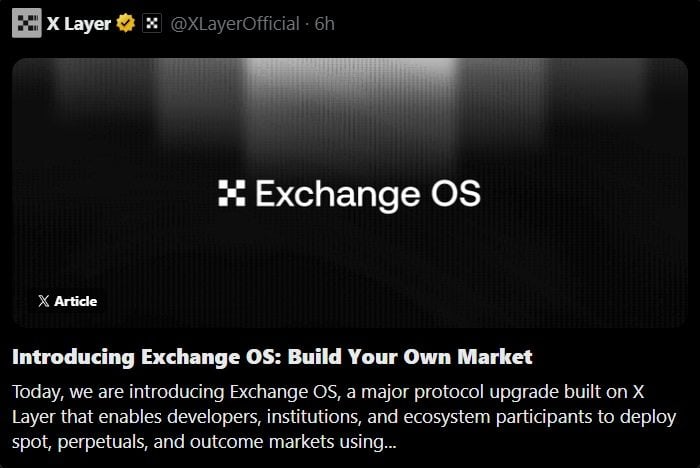
Onchan analytics provider Glassnode confirmed on May 26, that Exchange OS has launched on Xlayer, the L2 built by crypto exchange OKX. Exchange OS is a permissionless, builder-first protocol, meaning any developer or project can deploy their own spot trading markets, perpetual futures contracts, and prediction markets on top of the platform’s shared infrastructure without requiring approval from a central gatekeeper.
The protocol designates Glassnode as its official onchain data provider, supplying unified onchain, spot, and derivatives data to the Exchange OS ecosystem. Glassnode will power the data layer that market makers, traders, and builders rely on across Exchange OS venues, giving the platform institutional-grade data infrastructure from launch.
Xlayer is OKX’s purpose-built L2 network, designed to expand the exchange’s reach into decentralized finance ( DeFi). As an L2, Xlayer processes transactions faster and at lower cost than Ethereum’s mainnet while settling final state on Ethereum itself, inheriting its security guarantees.
By hosting Exchange OS on Xlayer, OKX has signaled its continued commitment to building permissionless DeFi infrastructure on top of Ethereum’s security layer, a strategy that positions Xlayer as a comprehensive onchain financial hub beyond just a simple bridge for OKX users.
Permissionless Market Creation Targets Perps and Prediction Trading
The permissionless model is what distinguishes Exchange OS from most existing decentralized exchanges, where adding a new trading pair or launching a new market type typically requires governance approval or a manual listing process. Under Exchange OS, any team can spin up spot, perpetual, or outcome markets on demand.
This mirrors what Uniswap pioneered for spot liquidity in earlier cycles, but extends the model to perpetual futures and prediction markets, two product categories with significantly higher volume potential.
The launch arrives as competition in the decentralized perpetual futures space intensifies, given that Hyperliquid also announced today a prediction market expansion, currently dominating the category with $170.29 billion in 30-day trading volume and $5.53 billion in TVL.
Exchange OS’s builder-first design could attract projects seeking to bootstrap custom markets without centralized gatekeepers, though attracting meaningful liquidity from scratch remains the core challenge for any new trading venue. For Glassnode, the partnership embeds its data products directly into a live trading protocol rather than limiting them to standalone subscriptions.
Bitcoin.com News also reported today that Binance Wallet integrated a platform called ‘Event Rush’ into its framework for onchain trading of real-world outcomes, a parallel development that mirrors how quickly the largest crypto ecosystems are moving to capture prediction market and outcome trading volume in 2026.